
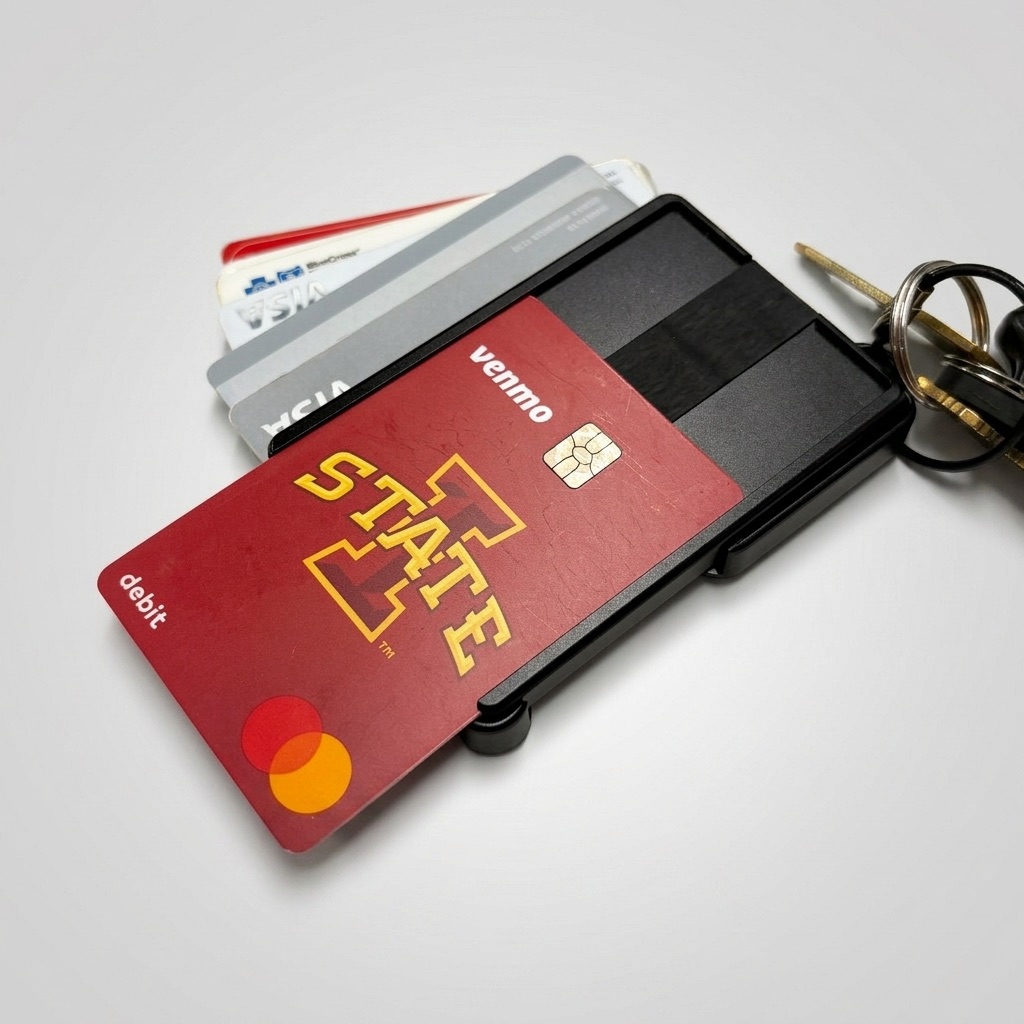
Choosing a wallet comes down to four variables: how many cards you carry, whether you carry cash, whether you carry keys separately or want them combined, and how much pocket bulk you'll tolerate. Get those four answers and the wallet choice becomes fairly obvious. Everything else, material, finish, brand, is secondary.
Most people pick wallets by how they look in the store. Then they use them for six months and realize the card capacity is wrong or the bulk is worse than expected. Starting from your actual carry habits is a more reliable approach.
Step one: count your actual cards
Empty your current wallet and count what you actually carry. Most people carry 4-8 cards regularly and have 3-6 more that they could leave home without. The number you carry daily is the number that matters for wallet sizing.
Slim wallets typically hold 4-8 cards. Traditional bifold wallets hold 8-12. If you're routinely carrying more than 10 cards, a slim wallet will either frustrate you or force a card audit. Both outcomes might actually be good.
Step two: assess your cash situation
Are you genuinely cashless, or do you occasionally need bills? If you haven't carried cash in a year, a cash slot is dead weight. If you regularly tip in cash or shop at places that prefer it, you need a bill solution.
Slim metal wallets typically solve this with an elastic band on the back. It holds folded bills securely without adding the bulk of a traditional billfold compartment. Not as tidy as a bifold, but adequate for people who carry cash occasionally rather than constantly.
Step three: think about your key situation
This step is easy to skip and worth taking seriously. Your keys leave the house every time you do. If they're separate from your wallet, you have two objects to track. If you've ever left one and not the other at the wrong place, you know the downside of the two-item setup.
- Minimal key count. Two to five keys. A wallet with a built-in keyring consolidates everything well. The key load is manageable as part of the wallet.
- Larger key count. Six or more keys, or keys with large fobs. A separate keychain probably makes more sense. The weight and bulk of many keys attached to a wallet starts defeating the slim-carry purpose.
- Wants zero separate objects. A wallet with keyring, tracker, and card storage in one unit is the right direction. See our guide on one-item carry for more on this philosophy.
Step four: decide on material
Leather ages well and looks traditional. Fabric is lightweight but wears quickly. Metal is the most durable but shows micro-scratches over time and can feel colder in the hand initially.
If durability and slim profile are priorities, machined metal is the strongest choice. If you want something that softens and develops character with use, good leather does that differently than metal does.
Putting it together
Once you've answered the four variables, the category of wallet you need is clear. From there, it's mostly a matter of budget and which features within that category matter to you: tracker, RFID blocking, keyring, finish.
The Metal Brik ($69.99) covers cards, cash, keyring, RFID protection, and a rechargeable tracking card in one package. If that combination matches your carry habits, see the Metal Brik for full details. If you're still comparing materials, see our guide on aluminum vs titanium wallet.
Not sure which slim wallet fits your carry style? Start with your card count and key situation, then browse the Metal Brik to see if the feature set lines up.
Quick answers
How many cards should a wallet hold?
Enough to cover your actual daily carry, typically 4-8 cards. Wallets that hold 12+ cards often encourage carrying cards you don't need, which adds unnecessary bulk.
Should I get a wallet with RFID blocking?
RFID skimming is a real but low-frequency risk. If you carry tap-to-pay credit cards or a contactless ID, RFID blocking on the main compartment is a reasonable feature to have. The cost difference is usually minimal.
Is a metal wallet too heavy for everyday carry?
Machined aluminum is light. The card weight inside the wallet typically outweighs the wallet frame itself. Most people switching from a stuffed leather bifold find the total carry weight goes down with a slim metal wallet, not up.