
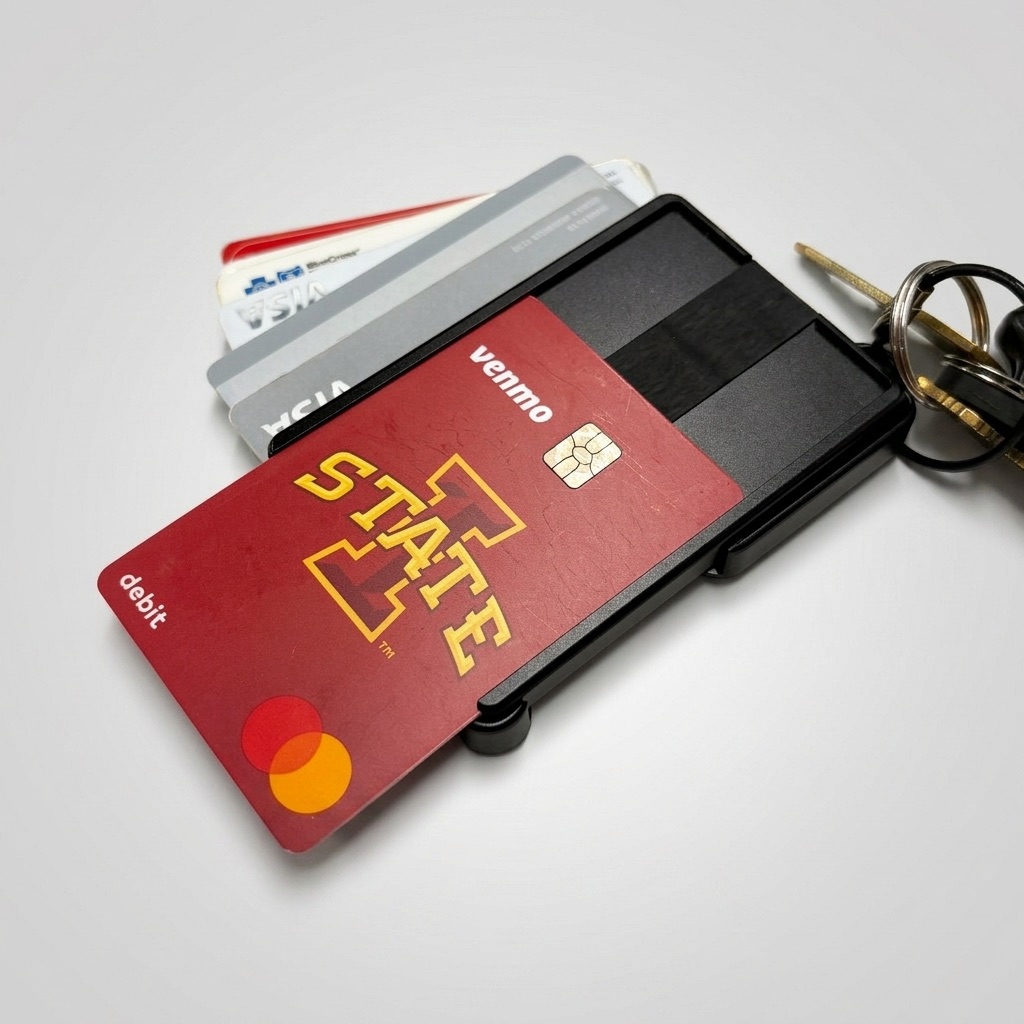
The one-item carry idea is simple: wallet, keys, cards, and ideally a tracker all live in a single object that leaves the house with you and comes back with you. No separate keychain to misplace. No wallet to leave on a counter. One thing, one pocket, one check at the door.
This is less of a philosophy and more of a practical system. If you've ever been locked out because your keys were in your other jacket, or found your wallet in a bag you stopped using, the appeal is obvious. Reducing the number of separate objects you track reduces the number of times you fail to track them.
What the one-item carry requires
For a single object to handle wallet, keys, and cards, it needs to be purpose-built for the combination. A leather bifold with a carabiner attached is not a one-item carry system. It's a two-item carry system held together by a clip.
The object needs a structural keyring attachment that keeps keys positioned without adding pocket bulk, RFID protection for cards, a cash solution, and enough card capacity for daily carry. Optional but useful: a tracker built into the card stack so you can locate or ring it from a phone.
Who the one-item carry works best for
This system works best for specific carry profiles.
- Minimal key count. Two to five keys. The key load stays manageable as part of the wallet unit. More keys than this and the bulk starts defeating the purpose.
- Daily commuters. If you're moving between transit, office, and home every day, one object to track is a meaningful quality-of-life improvement over managing three separate items.
- Travelers. Hotels, airports, and rental cars all require tracking multiple cards and keys in unfamiliar environments. A combined unit with a tracker is specifically useful here.
- People who lose things. If you've lost your wallet or keys more than once, the one-item carry cuts the number of losable objects in half. Adding a tracker cuts it further.
The tradeoffs
There are real tradeoffs worth considering. A combined wallet-keyring unit is slightly bulkier than a standalone minimalist card holder. If your ideal is a credit-card-thin wallet with nothing attached, a keyring is in the wrong direction.
Also, if you regularly need to hand your wallet to someone (valet, coat check) without handing over your keys, a detachable keyring matters. Make sure the system you choose allows that separation.
How the Metal Brik implements it
The Metal Brik ($69.99) is built specifically for the one-item carry. The machined aluminum body holds 7-8 cards in an RFID-protected compartment, plus an ID in a scannable front slot and cash under a back elastic band. A removable keyring attaches keys directly to the wallet. A card-shaped rechargeable tracking card locates or rings the wallet from a phone.
The keyring is removable, so you can hand the wallet without the keys when needed. The tracker has a battery that lasts up to 6 months per charge and recharges on any wireless charger.
If this is the setup you're after, see the Metal Brik for the full product page. For comparison with other slim wallets, see our guide on how to choose a wallet.
Ready to try a one-item setup? The Metal Brik ships in about one business day and arrives in a box ready to carry or give.
Quick answers
Is a one-item carry system actually practical?
For a minimal key count and daily carry, yes. The system works reliably when the object is designed for it. Retrofitting a regular wallet with a clip-on keyring usually doesn't work as well.
What if I need to give my wallet to someone without my keys?
A removable keyring solves this. The Metal Brik's keyring detaches, so you can hand the wallet alone when needed.
Does carrying keys with your wallet damage the wallet?
Not if the keyring is structural and the keys are positioned on the outside of the body. Keys attached to a designated ring point don't contact the card compartment or the main face.