
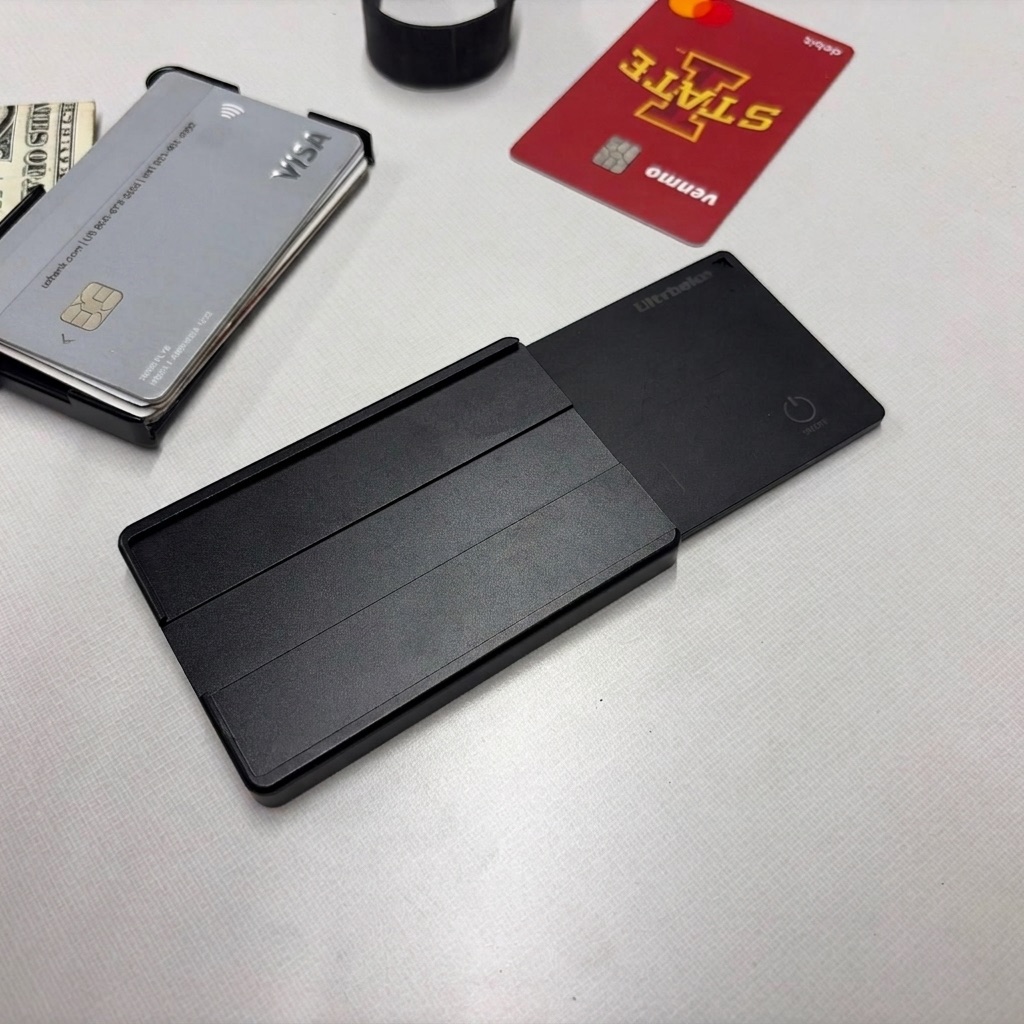
A wallet tracking card is a thin Bluetooth device the size of a credit card. It pairs with your phone, and when you lose your wallet you open an app to see its last known location on a map or trigger a sound to help you find it. That is the whole mechanism. No GPS, no cellular, just Bluetooth and a crowd-sourced network.
Bluetooth, Not GPS
Most people assume wallet trackers use GPS. They do not. GPS chips draw too much power and are too thick to fit in a card-shaped device. Instead, trackers use Bluetooth Low Energy (BLE), which sips battery and can reach 100-200 feet under ideal conditions.
When your wallet is within Bluetooth range of your paired phone, the app shows a live signal and can make the card ring. When it is out of range, the app shows the last location where your phone detected it. That last-seen location is often accurate enough to narrow it down to a room, a bar, or a rideshare.
How the Crowd Network Works
The real power comes from crowd networks. If your wallet is out of range of your own phone, other people's phones running the same app can silently and anonymously detect your card and relay its location to you. Apple's Find My network is enormous, with hundreds of millions of iPhones acting as passive relays. Tile has its own network as well. You never see who detected it, and they never know they helped.
This crowd detection is why an AirTag or a card that runs on Find My can locate something across a city. The more iPhones around, the faster the location updates.
What the Card Form Factor Changes
Traditional round trackers like the original Tile Mate or AirTag create a bulge in your wallet. Card-shaped trackers solve that by being credit-card thin. The trade-off has historically been battery life, since a thinner device fits a smaller battery.
Rechargeable tracking cards address this differently. Instead of a coin cell you swap once a year, they have a small rechargeable cell that tops up on a wireless charger. The The Brik tracking wallet uses exactly this approach: a removable card that slides out, charges wirelessly, and slides back in. Battery life is up to 6 months per charge.
For more on how built-in trackers compare to clip-on accessories, see the guide on built-in tracker vs clip-on.
Ringing vs Locating
Tracking apps give you two tools. First, you can ring the card if it is nearby. A small speaker inside plays a tone so you can follow the sound under a couch cushion or inside a bag. Second, you can view its location on a map for when it is genuinely lost somewhere else.
Ringing only works when the card is in Bluetooth range, typically under 100 feet. Map location works anywhere the crowd network has covered it. Both tools are useful in different scenarios, and neither requires you to install a second device.
Android vs Apple: Does It Matter?
Yes, it matters which ecosystem your tracker is built for. Apple Find My cards work best if you and the people around you use iPhones. Android-based trackers use Google's Find My Device network or Tile's network, which is growing but smaller.
If you are buying a tracking wallet as a gift or for yourself, it is worth thinking about which phone the person carries. Some wallets, including the Brik tracking wallet, let the buyer choose Apple or Android at checkout so the tracker is already matched to the right network.
Quick answers
Do wallet trackers work without cell service?
Yes. The tracker uses Bluetooth, not cellular. You need an internet connection on your phone to view the map location, but the card itself does not need a data plan.
Can someone else track me with a wallet tracker?
Apple's Find My network has built-in alerts that notify you if an unknown AirTag is traveling with you. Most reputable tracker ecosystems have added similar anti-stalking protections.
How accurate is the location?
In a crowd-dense area it can be within a few meters. In a rural area with few phones around, it may only show a general neighborhood. Ringing the card when you are close is more precise than map location.