
Phone, wallet, keys: three items, three pockets, three independent chances to ruin your morning. The fix is to cut three failure points down to two, anchor what remains to fixed spots, and let the two survivors find each other when one goes missing. Everything below is in service of that.
You already know the ritual. Hand hits front left pocket, front right, back right, small pause of dread, repeat. You perform it leaving the house, leaving the restaurant, leaving the car, and at least once mid-walk for no reason at all. It is the closest thing modern life has to a nervous tic, and it exists because your carry system has three moving parts.
The math of three failure points
Every time you move between locations, each item you carry is a separate opportunity to leave something behind. Three items across the six or eight transitions of a normal day is roughly twenty daily chances to lose something. Nobody bats a thousand across twenty chances forever.
Worse, the three items almost never go missing together. You will have your phone and keys but no wallet, or your wallet and phone but no keys, so some errand always dies at the last step. A three-item system does not fail catastrophically. It fails constantly, in small, stupid ways, which is arguably more annoying.
The fixes, ranked from free to full
You do not have to buy anything to improve this. Here is the ladder, cheapest first.
- The bowl by the door (free). One landing zone for all three items the moment you walk in. Brutally effective at home, useless everywhere else, and everywhere else is where you lose things.
- The same-pocket policy (free). Phone always front left, wallet always front right, keys always with the wallet hand. Your hands learn the map and the pat-down gets faster, though it does not disappear.
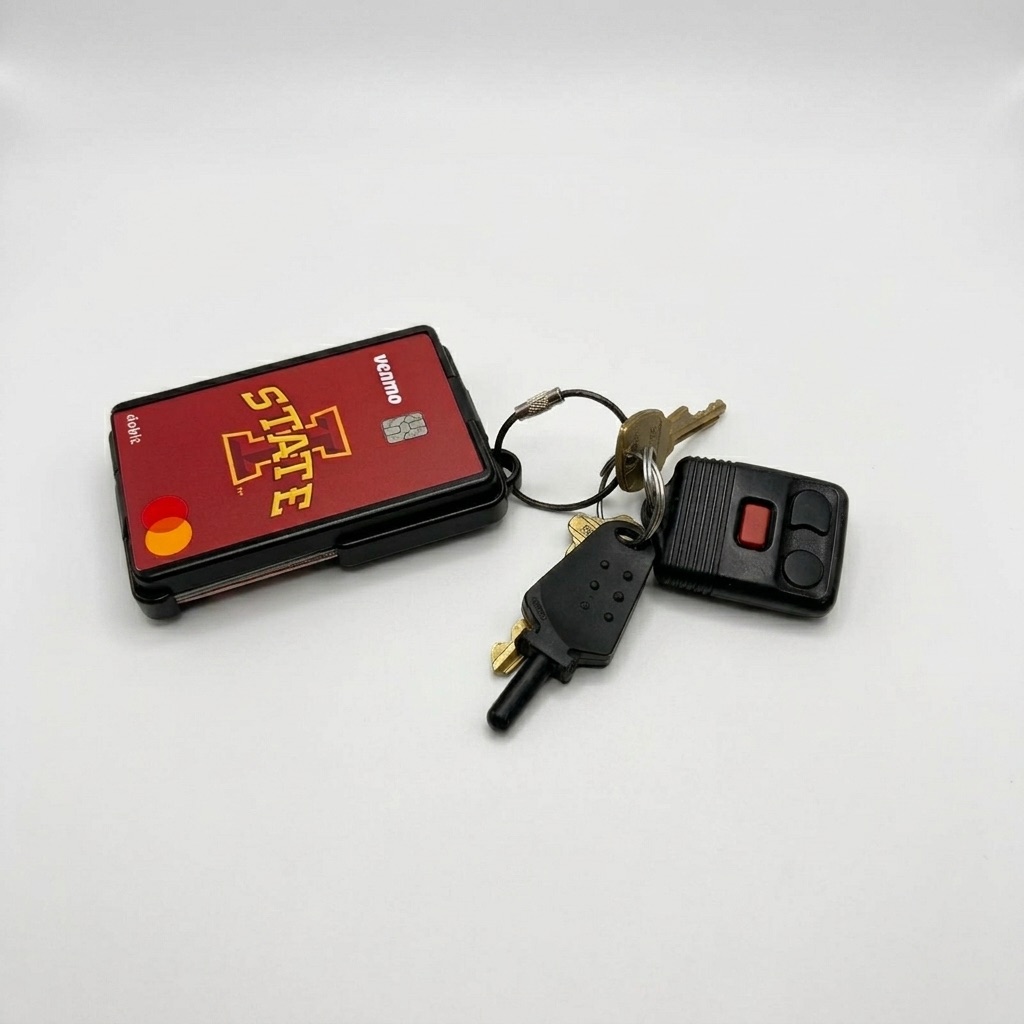
- Consolidate to two items. Attach your keys to your wallet so 'wallet' and 'keys' become one object. The check drops from three touches to two, and the keys can no longer be forgotten independently.
- Two items that find each other. The endgame: a wallet that carries your keys and holds a tracker, so your phone can ring it when it hides. Now each remaining item can locate the other.
What two-item carry actually looks like
In practice this means one phone and one EDC wallet that does everything else. The Metal Brik is a straightforward example of the pattern: 7 to 8 cards in an RFID-protected compartment, an ID in a quick-access slot, cash under a back elastic band, house and car keys on an included removable keyring, and a card-shaped tracking card you can ring or locate from your phone. Two objects, two pockets, one glance.
You can also assemble the pattern yourself with a key clip and a separate tracker. The specifics matter less than the principle: get to two items, and make sure at least one can be found by the other.
The honest case for and against consolidating
The case against is real: one object now holds your cards, cash, and keys, so losing it means locked out and broke simultaneously. If you consolidate without tracking, you have concentrated risk and mitigated nothing. That is a genuinely worse position, not a neutral one.
The case for: a single larger object is much harder to leave behind than a loose key fob, habit anchors are twice as effective when there is half as much to anchor, and tracking turns the rare catastrophic loss into a findable one. Keep the phone separate rather than going full one-item, because a phone wallet case means one drop takes out everything with nothing left to search from. Two items that can find each other is the stable end state for an everyday carry setup, and the pocket slap quietly retires.
Quick answers
Why not just use a phone case wallet and carry one item?
Because it removes your safety net. If the phone-wallet combo is lost or dies, you have no payment, no ID, and no device to track anything with. Two items that can locate each other beats one item that cannot.
Do habit anchors like a bowl by the door actually work?
Yes, at home, where roughly a third of misplacements happen. They do nothing for restaurants, gyms, and rideshares, which is why anchors work best combined with consolidation and tracking.
Is attaching keys to a wallet bulky?
It depends on the wallet. A design with an integrated keyring, like The Metal Brik's removable one, carries a few keys flat against the body instead of adding a keychain lump to your pocket.