
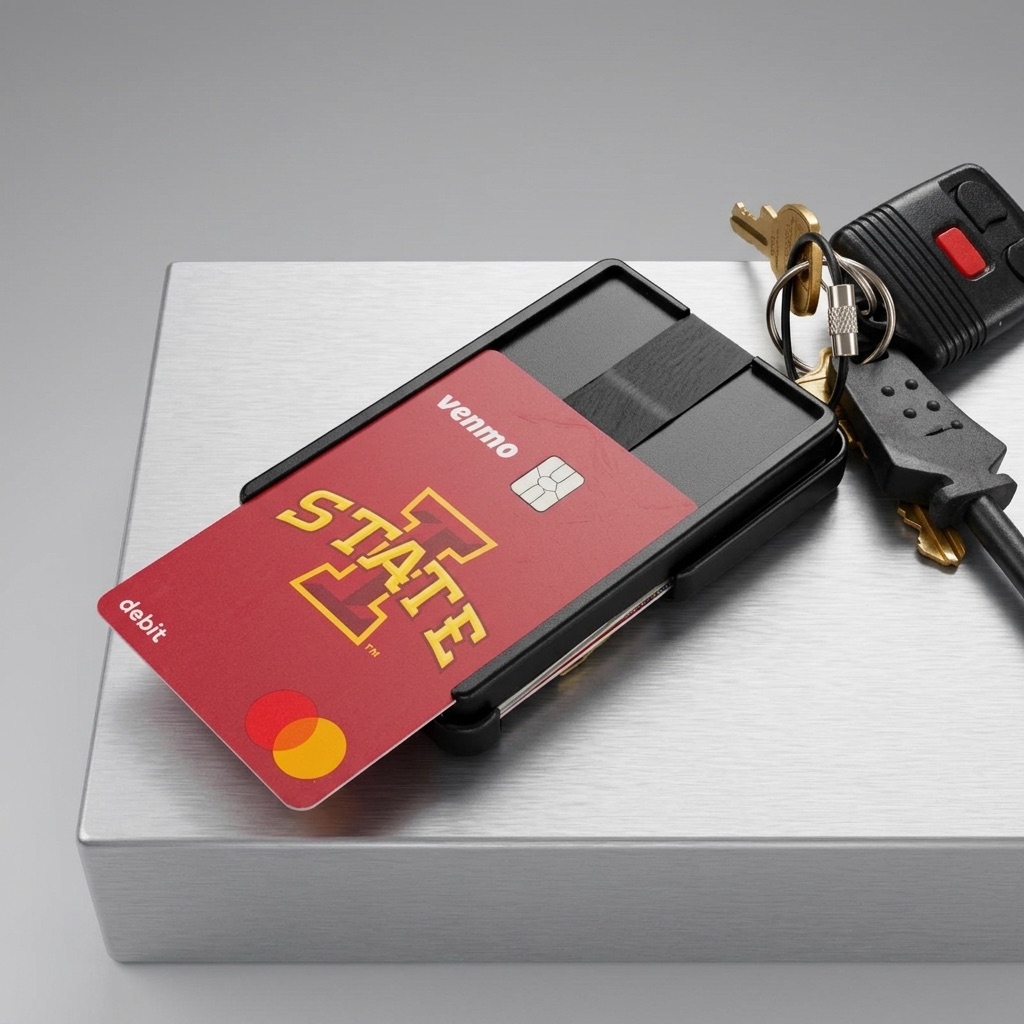
Your first office job requires five things on your person: your badge, an ID, one or two payment cards, your keys, and a way to pay for coffee. Everything else can live in a desk drawer. That is the whole answer. The rest of this article is about carrying those five things without a lanyard, a bulging pocket, and a mild panic every time you approach a card reader.
The first week of a new job is mostly logistics. You will badge into doors you did not know were locked, get invited on coffee runs you cannot dodge, and figure out which train actually gets you there by 8:55. Your carry should make all of that boring, which is the goal.
The first-week carry checklist
Here is what earns a spot in your pocket during week one. Notice how short this list is.
- Your badge. You will scan it at the front door, the elevator, the printer, and sometimes the bathroom. It is the one item you cannot forget without an awkward call to security.
- One primary card and one backup. A debit or credit card for coffee runs and lunch, plus a backup in case the first one gets declined in front of your new manager.
- Your ID. Building security, HR paperwork, and the bar your team goes to on Thursday all want to see it.
- Transit card or pass. If you commute, this gets used twice a day, every day. It should be reachable in under two seconds.
- Keys. House, car, and eventually an office key or drawer key. Losing these costs real money. Ask anyone who has paid a locksmith.
- A little folded cash. Twenty bucks covers the food truck that is cash only and the group lunch where someone insists on splitting the bill by hand.
Why the lanyard fails after week one
Every new hire starts with the lanyard, because it comes free with the badge. Then the lanyard dips into your coffee. It snags on the train door. It flips backward during a handshake. Most fatally, it comes off the moment you sit down, which means it stays on your desk when you leave for lunch, and eventually when you leave for the day.
A badge that lives on a lanyard is a badge that gets separated from you daily. A badge that lives with your cards leaves the building every time you do. Replacement badges are usually somewhere between annoying and expensive, and the email to facilities never feels great in month one.
Consolidating badge, cards, and keys
The upgrade path is simple: put the badge where your cards already are. A proper wallet for professionals holds the badge in a spot that still scans, so you tap the whole wallet against the reader and walk through without fishing anything out.
This is the setup The Metal Brik was built around: a quick-access front slot that stays scannable for tap badges and IDs, an RFID-protected main compartment for 7 to 8 cards, folded cash under a back elastic band, and a removable keyring for your office and house keys. One item covers the door, the coffee, and the commute home. If you are staring down a first job and want the pat-your-pockets ritual gone before orientation ends, a consolidated professional wallet is the single highest-leverage swap you can make.
Desk drawer kit vs pocket carry
Everything that is not on the five-item list goes in a desk drawer kit: phone charger, spare cable, snacks, painkillers, deodorant, an umbrella, and a granola bar for the meeting that runs through lunch. The drawer is for comfort. The pocket is for access.
The dividing rule: if you would need it when the building is closed, it goes in your pocket. If you would only need it while sitting at your desk, it stays in the drawer. Follow that rule and your carry stays flat for the next forty years of employment.
Quick answers
Should I carry my work badge everywhere?
Yes, treat it like a card, not an accessory. If it lives with your payment cards, it leaves the building whenever you do, which is exactly when badges get left behind on desks and lanyards.
Will my badge still scan inside a wallet?
It depends on the wallet. RFID-blocking compartments will stop it from reading. Look for a wallet with a non-blocked quick-access slot, like the front slot on The Metal Brik, which stays scannable for tap badges.
What should stay in my desk drawer instead of my pockets?
Chargers, cables, snacks, painkillers, an umbrella, and anything else you only need while at your desk. Pockets are for badge, ID, cards, keys, and a little cash.